
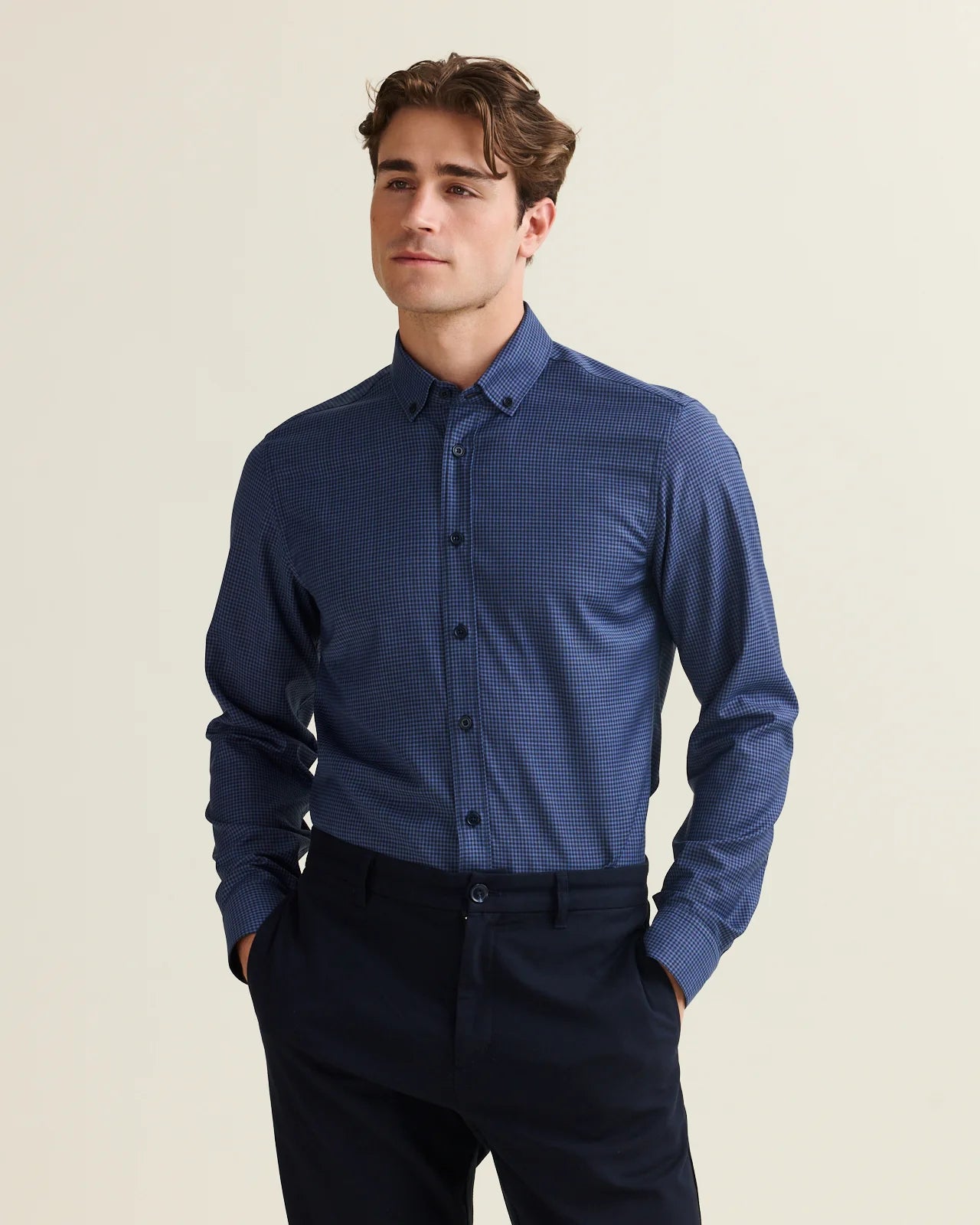

If you've ever pulled a cotton shirt out of a suitcase, or looked down at your sleeves after a long day at the office, you know the problem. Cotton creases, and those creases stay until you iron them out. Merino wool behaves differently. A merino shirt comes out of a bag smooth, and it still looks sharp after a full day of meetings, commuting and rolled-up sleeves.

Packing merino wool shirts for a business trip.
The short answer: merino fibers are naturally crimped and made of keratin, a protein whose internal bonds pull each fiber back into shape after it's bent or compressed. Cotton and linen are made of cellulose, which has no such spring-back, so they need an iron or a chemical resin finish to stay smooth. Below, we explain the science, compare merino with cotton, linen and polyester, and look at what it means for your day.
The Natural Structure of Merino Wool Fibers
Under a microscope, merino fibers look like tiny coiled springs, and that is exactly how they behave. Each fiber has a natural wave, called crimp, that lets it stretch, bend and return to its original shape. Sit in a merino shirt for hours or fold it tightly into a bag, and the fibers simply spring back.
The protein inside the fiber matters just as much. Wool is made of keratin, the same protein found in human hair and nails. Keratin molecules are coiled and held together by chemical bonds, including hydrogen bonds and disulfide bridges. These bonds work like internal springs: when the fiber is bent or compressed they flex, and when the pressure is released they pull the fiber back into its natural position.

Close-up of merino wool fiber crimp structure showing natural elasticity in the keratin molecules.
Cotton and linen are made of cellulose, which lacks this mechanism. That's why they crease so easily and hold those creases so stubbornly.
Textile scientists call this elastic recovery: how completely a material returns to its original shape after being stretched or deformed. Wool has one of the highest elastic recovery rates of any natural fiber, and it's remarkably durable too. A single wool fiber can be bent back on itself more than 20,000 times without breaking.
What the Research Says
Wool's wrinkle resistance isn't just a marketing story. Textile research consistently shows that the coiled keratin structure gives wool far higher elastic recovery than cellulose fibers like cotton and linen. At small extensions, the kind a shirt goes through every time you move, a wool fiber returns almost completely to its original length.
The industry measures crease behavior with the wrinkle recovery angle test. A fabric sample is folded under a set weight, released, and the angle it springs back to is measured after a fixed time. The higher the angle, the better the recovery. Wool scores well above cotton and linen in these tests and comes close to synthetics, while keeping the breathability and moisture management that synthetics lack.
How Moisture Helps Merino Recover
Merino wool is hygroscopic: it absorbs and releases water vapor from the air around it, and it can take up around 30% of its own weight in moisture before it feels wet. That's great for comfort, and it plays a role in wrinkle recovery too.

Warmth and moisture temporarily loosen the hydrogen bonds inside the keratin. When the fiber is free to relax, those bonds reform in its natural, smooth configuration. That's why a light crease often disappears during the day as your body heat and the humidity around you do the work, and why hanging a merino shirt in a steamy bathroom works so well. The same mechanism explains why tailors can press a sharp crease into wool trousers with a damp cloth and an iron. So when you wash your shirt, hang it to dry instead of leaving it crumpled.
Merino vs. Cotton, Linen and Polyester
Merino outperforms most common shirt fabrics on wrinkle resistance, but not every fabric falls short in the same way, or for the same reason.
| Fabric | Wrinkle resistance | Elastic recovery | Odor resistance | Travel suitability |
|---|---|---|---|---|
| Merino woolProtein (keratin) | Excellent (5 out of 5) | Very high (5 out of 5) | Excellent (5 out of 5) | Excellent (5 out of 5) |
| CottonCellulose | Poor (2 out of 5) | Low (2 out of 5) | Moderate (3 out of 5) | Poor (2 out of 5) |
| LinenCellulose | Very poor (1 out of 5) | Very low (1 out of 5) | Moderate (3 out of 5) | Very poor (1 out of 5) |
| PolyesterSynthetic | Good (4 out of 5) | High (4 out of 5) | Very poor (1 out of 5) | Moderate (3 out of 5) |
| Synthetic blendsMixed | Moderate (3 out of 5) | Moderate (3 out of 5) | Varies (3 out of 5) | Moderate (3 out of 5) |
Scores on a 5-point scale, based on typical fiber properties.

Cotton shirt versus merino wool dress shirt.
Cotton is the most common fabric for dress shirts, and one of the weakest when it comes to creasing. Its cellulose fibers have no crimp and very little elasticity, so once they're folded or compressed, they stay that way. A cotton shirt can look perfect on the hanger and crumpled after a two-hour meeting. Linen is worse still and wrinkles within minutes of putting it on. Some people love that as part of linen's character, but it isn't practical for business or travel. Both fabrics also absorb sweat and hold on to it, so they dry slowly, feel clammy by the end of the day and start to smell sooner than merino.
Polyester is the one common shirt fiber that genuinely resists wrinkles. It's a thermoplastic fiber, heat-set into shape during manufacturing, so it springs back well at body temperature. The trade-off is comfort. Polyester absorbs almost no moisture, so sweat stays on your skin instead of being taken up by the fabric, and the shirt feels warm and sticky in a heated office or on a crowded train. Polyester also attracts and holds the oily compounds in sweat, which is why synthetic shirts start to smell sooner than natural fibers and often keep that smell even after washing. Poly-cotton blends sit somewhere in between: fewer creases than pure cotton, but less breathable.
Merino gives you the wrinkle resistance of polyester through the natural structure of the fiber, while it also breathes, regulates temperature and resists odor in a way polyester can't match.
What About No-Iron Cotton Shirts?
No-iron, wrinkle-free and easy-care cotton shirts look like a simple answer to the wrinkle problem. But cotton doesn't become crease-resistant on its own. Because cellulose fibers have no natural spring-back, manufacturers create the effect chemically, with a resin finish that crosslinks the cellulose molecules so the fabric holds a flat shape.
The most widely used agent is DMDHEU (dimethylol dihydroxyethylene urea), a resin that releases formaldehyde. Older finishes based on urea-formaldehyde and melamine-formaldehyde resins released even more. Many mills now use modified, low-formaldehyde versions of DMDHEU, and formaldehyde-free alternatives such as polycarboxylic acids (citric acid or BTCA) exist, but they're more expensive and less common. The resin is often combined with a liquid ammonia pre-treatment and silicone softeners to offset the stiffness the finish creates. The crosslinking also makes cotton fibers more brittle, which lowers the fabric's tear and abrasion strength.
For most people that's not a problem, but formaldehyde and textile resins are known contact allergens. Reactions, from itching to an eczema-like rash, usually show up where fabric rubs against warm skin: the neck, armpits, inner elbows and waistline. Heat and sweat increase the release, so symptoms tend to peak after a long, warm day. Dermatology research links formaldehyde textile resins to roughly 1.2 to 6.2% of allergic contact dermatitis cases diagnosed through patch testing. OEKO-TEX limits free formaldehyde in skin-contact textiles to 75 ppm, and washing a new shirt before wearing it helps. Still, the resin does all the work: without it, a no-iron shirt creases like any other cotton shirt.
Merino starts from a different place. Our own shirts do have a finish, but it has a different job: it makes the wool machine washable, so your merino dress shirt doesn't shrink or felt in the wash. The wrinkle resistance comes from the wool fiber itself.
Why Fiber Diameter Matters
Not all merino is the same. Wool quality is measured by fiber diameter in microns, and one micron is a thousandth of a millimeter. Thicker fibers bend less easily, so when they're compressed, they're more likely to crease and hold it. Finer fibers are softer and more flexible, and that flexibility helps them recover from creases.
Superfine merino, roughly 17 to 19 microns, bends easily and returns to shape more completely. So the same quality that makes a merino shirt feel smooth against your skin also helps it resist permanent creasing.

Wool fiber thickness grades.
Wolk shirts are made from superfine 17.5-micron merino wool. The fabric is woven in Italy and the shirts are sewn in Portugal, where European manufacturing standards apply tight controls over spinning, weaving and finishing. Careful processing preserves the natural crimp of the fiber, and that's what keeps a shirt performing the same after 50 washes as on day one.
From Suitcase to Meeting to Dinner
The real test of a shirt isn't how it looks on the hanger, but how it looks at the end of a long day. Pack a cotton shirt and a merino shirt in the same bag and unpack them after a flight: the cotton shirt needs an iron, the merino shirt is ready to wear. No hunting for a hotel iron, no waiting for a steamer that may not be there, and no need to pack a spare shirt for every day of the trip.
The same recovery works for you all day. Hours at a desk, a commute or a flight, a seatbelt across your chest, sleeves rolled up while you work: these are the moments that leave a cotton shirt creased at the elbows and crumpled at the waist. With a merino button-up shirt, you roll your sleeves back down before dinner, the folds are hardly noticeable, and the creases from sitting relax out as you move.

From office to dinner in the same shirt without worry: Wolk merino wool comfort
So the shirt you wore to your morning meeting still looks impeccable for an evening out. Hang it overnight and it's smooth again the next morning, and because merino also resists odor, wearing it a second day is a realistic option. For a three-day trip, you might pack one merino shirt where you'd have packed three cotton ones. That's exactly what our merino wool business shirts are made for.
Does Merino Wool Ever Wrinkle?
Yes, a little, and it's more useful to be honest about that than to oversell it. Merino is highly wrinkle-resistant, not wrinkle-proof.
If you sit in one position for many hours, or ball up a shirt and leave it compressed in a bag for days, you may see some creasing. Those creases are usually shallow and temporary, nothing like the deep, set-in wrinkles of cotton or linen. In normal wear and travel, most people will never notice them.
When a crease does appear, it's easy to fix. Hang the shirt in a steamy bathroom for 15 to 20 minutes, or mist it lightly with water and give it a shake. Body heat and movement often do the same while you wear it. If you prefer to iron, a steam iron works well directly on the fabric. Just check the care label for the recommended setting. The fiber responds quickly to steam, so it takes very little effort.
To keep that performance for years, don't store merino tightly folded in an overfull drawer for weeks on end. Hang your shirts or fold them loosely so the fibers keep their natural crimp.
Caring for Merino Wool Shirts
Merino is less demanding than most people expect. Thanks to the machine-washable finish, you can wash Wolk shirts in the machine at 30°C with a wool detergent, and because merino resists odor, you'll wash them less often than cotton. For all the details, see our merino wool care page.


