
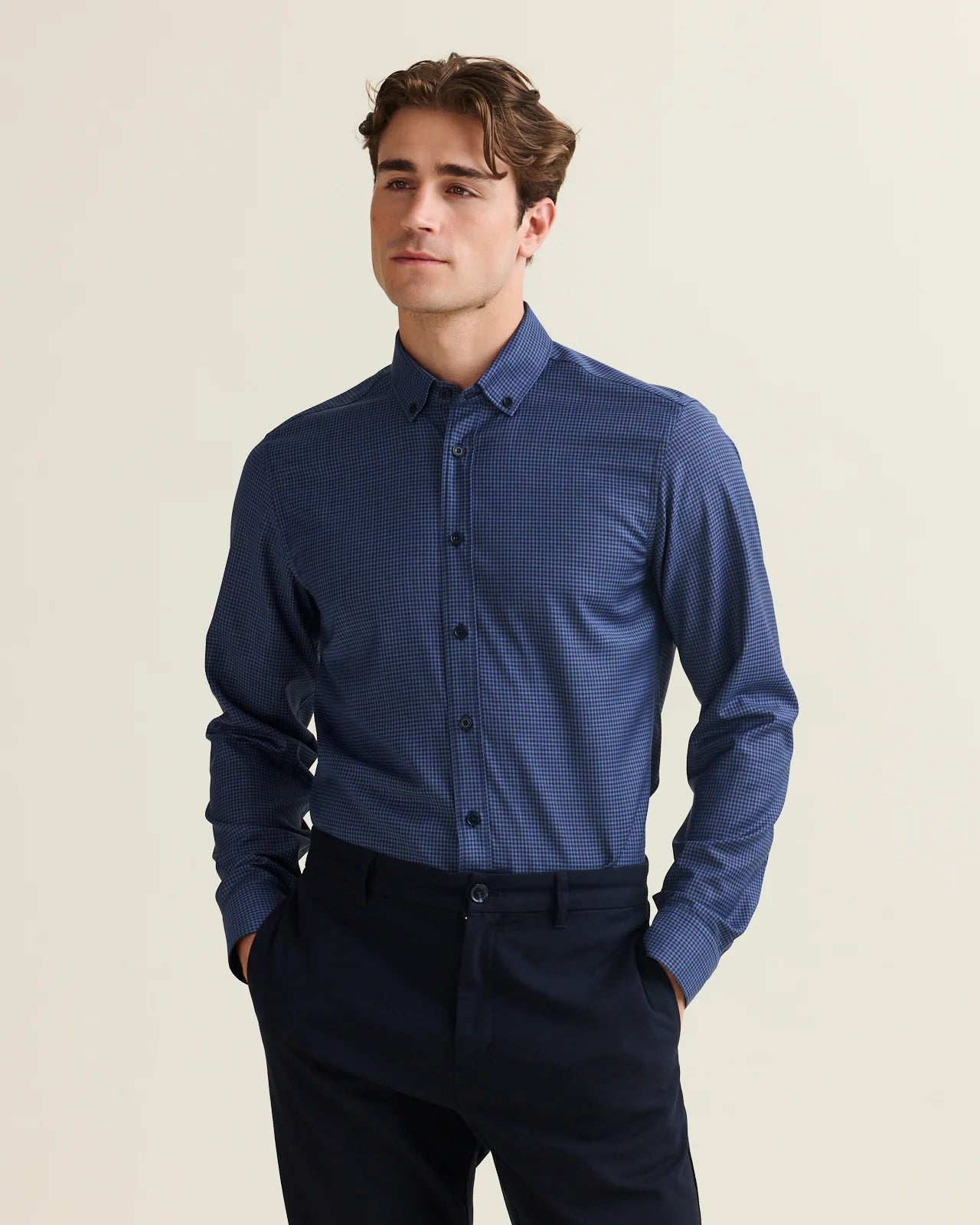

Yes. Merino wool is one of the warmest fabrics you can wear for its weight, and unlike most warm fabrics, it doesn't leave you overheated the moment you step into a heated office or onto a crowded train. Merino traps still air in its crimped fibers, keeps insulating when it gets damp, and releases excess heat and moisture when you warm up. That combination is what makes it so good for a European winter, where you're constantly moving between cold streets and warm rooms.
How warm a merino garment feels depends less on the fiber than on the fabric: a 135 g/m² shirt and a 183 g/m² flannel are both 100% merino, but they're made for very different days. Below, we explain how merino keeps you warm, which weights to wear when, how to layer, and how merino compares with cotton flannel, cashmere and fleece. For the full background on the fiber, see our guide to merino wool.
How Merino Wool Keeps You Warm
It traps air. Merino fibers have a natural wave, called crimp. Millions of these tiny waves create small pockets of still air between the fibers, and still air is one of the best insulators there is. That's why a merino garment feels warm without feeling heavy.
It stays warm when damp. This is wool's biggest advantage in winter. Merino absorbs moisture vapor into the core of the fiber, around 30% of its own weight before it feels wet, so the surface against your skin stays dry. Cotton does the opposite: it soaks up sweat or rain, stays wet and pulls heat away from your body. As wool absorbs moisture, it even releases a little heat, which helps just when the weather turns cold and damp.
It regulates. When you warm up, on a brisk walk, a packed tram or in an overheated meeting room, merino moves the extra moisture and heat away from your skin instead of trapping it. You avoid the cycle of sweating indoors and then feeling chilled outside. It's the same fiber structure that helps merino resist wrinkles, and it's why a merino shirt still looks and feels fresh at the end of a long winter day.
It's soft enough to wear against the skin. Traditional wool is coarse and itchy. Superfine merino, 17.5 micron in our shirts and sweaters, is fine enough that most people don't feel any itch at all, which matters when your base layer is on your skin all day.
Why Fabric Weight Matters More Than You Think
Our shirts and sweaters are made of superfine merino, but the way the wool is woven or knitted decides how warm a garment is. Fabric weight, measured in grams per square meter (g/m²) for woven shirts, is the quickest guide:
| Piece | Fabric | Weight | Best for |
|---|---|---|---|
| Merino T-shirt | ClimaForce merino jersey | Light | Base layer, all year |
| Merino dress shirt | Superfine merino poplin or twill | 135 g/m² | Heated offices, under a sweater or blazer |
| Arne merino denim | Merino-lyocell denim twill | 177 g/m² | Cold days, on its own or under a jacket |
| Arne flannel shirt | Brushed merino flannel | 183 g/m² | Cold days, on its own or as a light overshirt |
| Merino sweaters | Knitted, 615 g to 1,240 g (size L) | Mid to heavy | Mid layer, from cool to properly cold |
A lighter shirt isn't a worse winter shirt: under a sweater, a 135 g/m² merino shirt is exactly what you want, because it breathes in a warm office. But if you want a shirt that keeps you warm on its own, go for the heavier denim or the flannel.
The Best Merino Pieces for Winter
Merino Flannel Shirts: Warm Without the Bulk
Our Arne merino flannel shirts are woven in Biella, Italy, from 183 g/m² superfine merino and brushed on the surface for a soft, warm handle. They're not as thick as some heavy cotton flannels, and that's the point. The warmth comes from the merino, not from the bulk. A thick cotton flannel keeps you warm until you start moving, then gets too hot, turns clammy and stays that way. Merino flannel gives you the warmth you need while it keeps breathing, so it works on a cold walk to the station and at your desk an hour later. It also sits cleanly under a coat or jacket without bunching.
Arne comes in three colorways: navy mélange, an asphalt-chestnut plaid and a moss-indigo check. Or, as one customer put it: "Really well cut, soft, fine and warm." (Axelle, Arne flannel shirt, translated from French)
Merino Denim Shirts
The Arne merino denim shirt is our heaviest denim: a 177 g/m² twill woven in Biella, Italy, from 76% superfine merino and 24% lyocell, in dark navy. The denim weave and extra weight make it a shirt that keeps you warm on its own on cold days, and it's dyed without indigo, so it won't fade the way jeans do. One customer summed it up: "It is warmer than the 100% merino shirts but I just like that."
Merino Sweaters and Cardigans
Knitwear is where merino does its best winter work. Our merino sweaters and cardigans range from the mid-weight Phil (615 g in size L) to the heavy Viggo full-zip (1,240 g), all knitted in Portugal from 17.5 to 18.5 micron superfine merino. The yarn is Harmony 4.0 from Tollegno, a spinning mill in Biella, Italy. It's spun with a compact, high-twist technique that locks the fibers tightly into the yarn, so the sweaters are far less prone to pilling and hold their shape season after season. Read more about it on our knitwear yarns page.
"Super warm. Not at all scratchy. Definitely the best jumper I own." (Customer review, Viggo merino full-zip sweater)
Merino T-Shirts as a Base Layer
A merino T-shirt under your shirt or sweater is the simplest way to add warmth without adding bulk. It manages moisture right where you produce it, against your skin. Our merino T-shirts are made of ClimaForce, a merino yarn reinforced with a fine nylon core filament, so they hold up to daily wear and frequent washing far better than 100% merino T-shirts.
Merino Dress Shirts for the Office
Our all-season merino dress shirts aren't winter shirts on their own, but they're the best shirts to wear under winter layers. Every one of them layers comfortably under our knitwear. Under a sweater or blazer in a heated office, a cotton shirt traps sweat and turns clammy. A merino shirt breathes, stays fresh all day and still looks sharp when you take your sweater off.
How to Layer Merino Wool in Winter
Layering works because each layer does its own job. Merino is good at every one of them.
- Base layer: a merino T-shirt against the skin, to manage moisture and keep you dry.
- Mid layer: a merino shirt, flannel shirt or sweater, to trap warm air.
- Outer layer: a coat or jacket, to block wind and rain. Because your merino layers manage heat and moisture so well, you often need a lighter coat than you'd expect.
A few combinations that work:
- Office: merino T-shirt, merino dress shirt, Phil sweater, wool coat. Take the sweater off indoors and you're still dressed for a meeting.
- Weekend: merino T-shirt and an Arne flannel or merino denim shirt, with a sweater on top on the coldest days.
- Commuting by bike or on foot: merino T-shirt and flannel shirt under a windproof jacket. You'll arrive warm but not sweaty.
- Winter travel: merino T-shirt, light shirt and a full-zip sweater you can open and close as temperatures change between platforms, trains and hotels.
Merino Wool vs Other Winter Fabrics
| Fabric | Warmth for its weight | Warm when damp | Breathability | Odor resistance | Durability |
|---|---|---|---|---|---|
| Merino wool | Good (4 out of 5) | Excellent (5 out of 5) | Excellent (5 out of 5) | Excellent (5 out of 5) | Good (4 out of 5) |
| Cotton flannel | Moderate (3 out of 5) | Very poor (1 out of 5) | Moderate (3 out of 5) | Moderate (3 out of 5) | Moderate (3 out of 5) |
| Cashmere | Excellent (5 out of 5) | Moderate (3 out of 5) | Good (4 out of 5) | Good (4 out of 5) | Poor (2 out of 5) |
| Fleece (polyester) | Good (4 out of 5) | Moderate (3 out of 5) | Poor (2 out of 5) | Very poor (1 out of 5) | Moderate (3 out of 5) |
| Synthetic thermal | Moderate (3 out of 5) | Moderate (3 out of 5) | Poor (2 out of 5) | Very poor (1 out of 5) | Good (4 out of 5) |
Scores on a 5-point scale, based on typical fiber and fabric properties.
Merino vs cotton flannel: cotton flannel feels cozy, but cotton absorbs moisture and holds on to it. Once you've warmed up, a cotton flannel turns damp and cold, and thick cotton flannel gets hot and bulky under a coat. Merino flannel is warmer for its weight, stays warm when damp and keeps breathing.
Merino vs cashmere: cashmere is warmer for its weight and wonderfully soft, but it's much more delicate. It pills faster and wears through at the elbows sooner. For pieces you wear several times a week, merino is the more durable choice.
Merino vs fleece: fleece is warm and light, but it's polyester. It doesn't breathe well, it holds on to odor, and it's hard to wear in an office or a restaurant. Merino gives you similar warmth in a fabric you can wear anywhere.
Merino vs synthetic thermals: synthetic base layers dry fast, but they trap odor quickly and feel clammy once you're indoors. A merino T-shirt is the more comfortable choice for a full day.
Caring for Merino in Winter
Merino is easier to look after than most people expect, and in winter you'll wash it even less.
- Air it instead of washing it. Merino resists odor, so after a day's wear, hanging it overnight in fresh air is often enough.
- Wash cool. Our shirts and T-shirts can go in the washing machine at 30°C with a wool detergent.
- Dry woven shirts on a hanger, knitwear flat. Hanging lets a shirt's creases relax out as it dries. A sweater dried on a hanger stretches, so lay it flat on a towel.
- Keep it off the radiator. Direct heat dries out and weakens wool fibers. Dry your merino at room temperature.
- Store it clean. At the end of winter, wash your knitwear before you put it away, and store it folded in a breathable bag. Moths go for wool that still carries traces of skin and sweat.
For all the details, see our merino wool care page.
Responsibly Sourced Merino
Warmth shouldn't come at the cost of animal welfare. The wool in our shirts is ZQ-certified, and our T-shirts and socks use RWS-certified wool. Both standards prohibit mulesing and set strict requirements for animal welfare and land management. The wool in our knitwear is mulesing-free as well.
Find Your Winter Layers
Whether you need a warm flannel shirt for the weekend, a sweater for the office or a merino T-shirt to wear under everything, our warm winter merino collection brings together the pieces that keep you comfortable from the first cold morning to the last.


